Pork Aggregate: Moving from a Price Logic to a Margin Logic
A pork producer can make a good decision on hog prices… and still see their margin deteriorate.
Why?
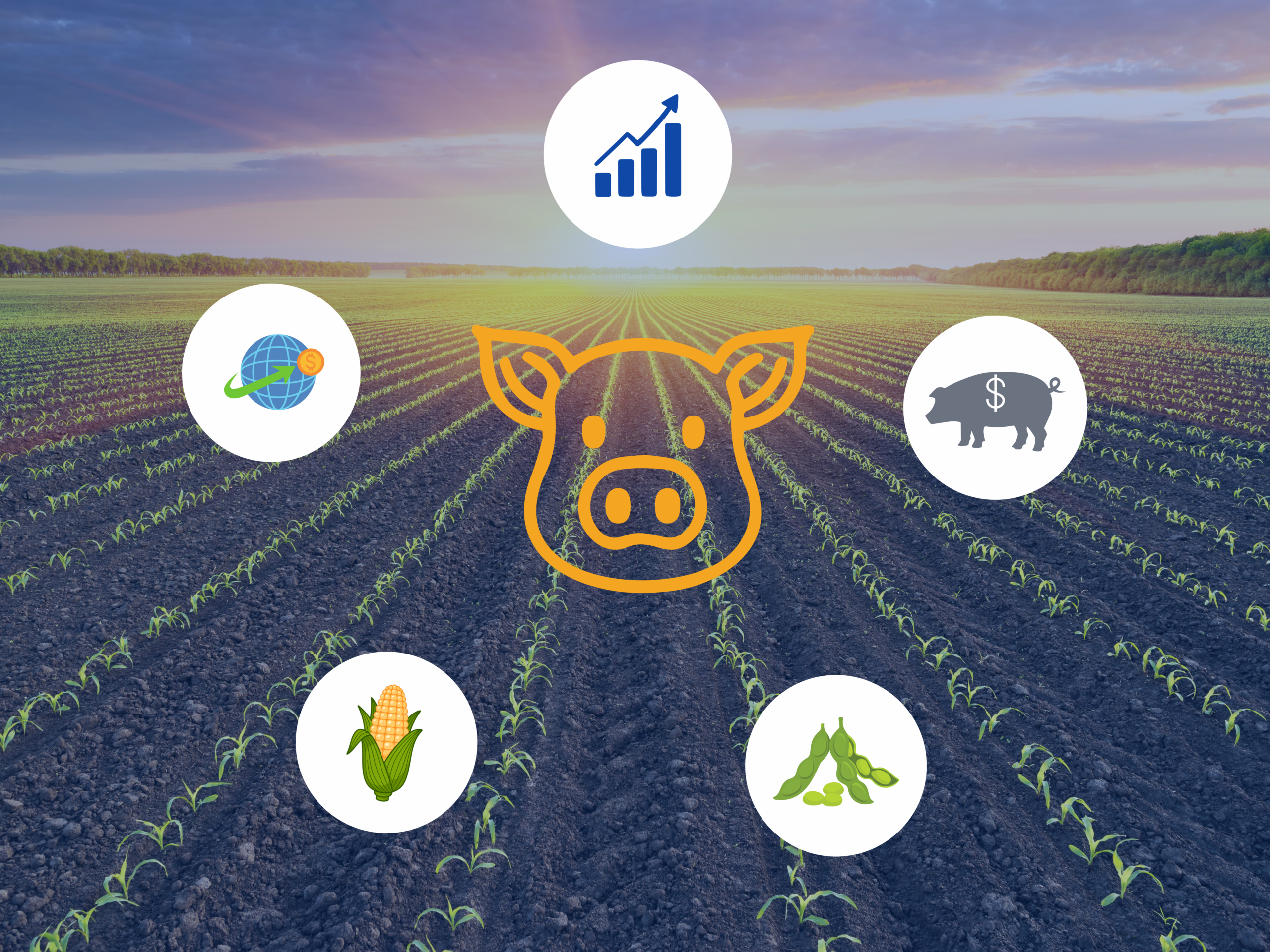
Because the profitability of a pork operation never depends on a single market. It relies on several variables evolving simultaneously:
- The selling price of hogs
- The cost of piglets
- The price of corn
- The price of soybean meal
- The CAD/USD exchange rate.
These markets influence each other every day. Yet they are often managed separately.
At Agrintel, we believe it is necessary to move from a price logic to a margin logic.
An integrated approach to risk
The Pork Aggregate combines all interdependent positions into a single hedging strategy.
Rather than hedging only the hog price, the approach integrates:
- Hog sales (HE)
- Piglet purchases
- Corn purchases (ZC)
- Soybean meal purchases (ZM)
- Exchange rate management (D6).
The objective is not to predict the markets.
The objective is to reduce the impact of their volatility on the operation’s margin.
To compare these markets with one another, each position is converted to a common basis: Canadian dollars per 100 kg of pork produced. This makes it possible to measure the real impact of each market on the overall profitability of the operation.
What the historical data shows
The charts below present the different components monitored by the Pork Aggregate between April 14, 2025, and April 14, 2026.
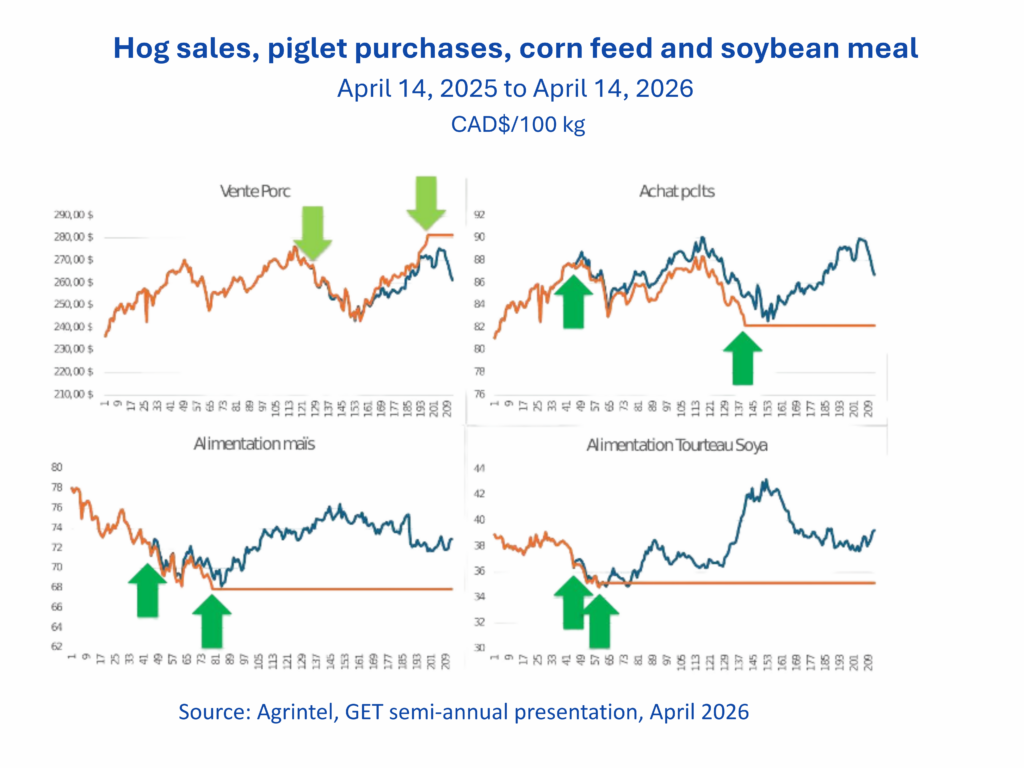
The blue curve represents the actual market price, subject to daily volatility.
The orange curve represents the price locked in by positions taken by the algorithm.
The arrows indicate the moments when positions were taken:
- Either to lock in the exchange rate
- Or to secure a futures contract price.
The exchange rate is hedged differently depending on the objective:
- To protect input costs
- Or to protect the selling power of hogs.
These decisions do not follow a fixed schedule. They are triggered when opportunities appear in each market. Building a true aggregate therefore requires time, generally close to a full year.
The second chart presents the combined result of these hedges: the Feed Cost Margin (FCM).
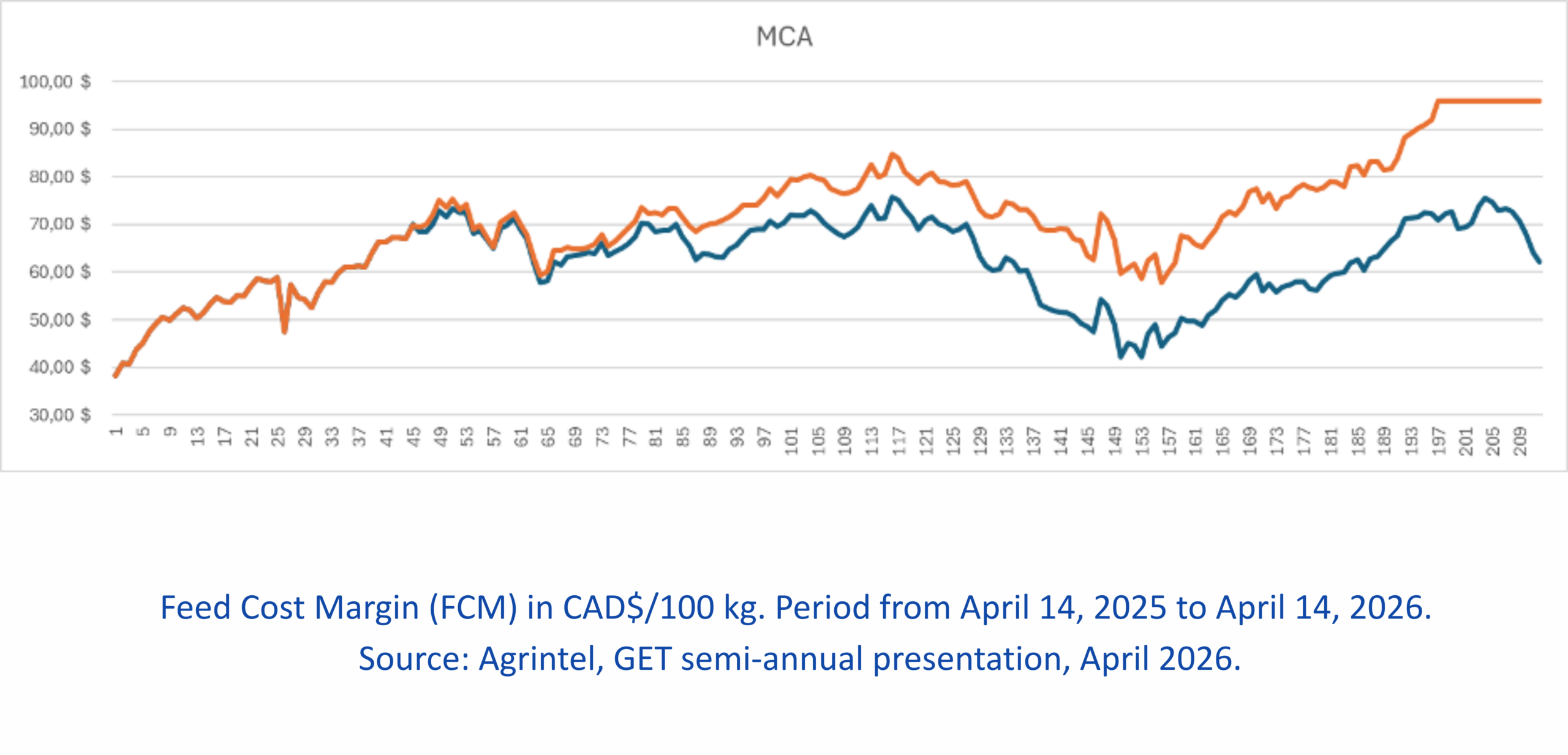
What we observe is not the elimination of risk, but a significant reduction in margin fluctuations. Where the market alone leaves the producer exposed to full volatility, the aggregate aims to make the operation more stable, more predictable, and more resilient.
An economic logic rather than a speculative logic
Over the 2015–2019 period, the Pork Aggregate generated an estimated cumulative potential gain of approximately $34.50 per hog (excluding exchange rate effects).
Over the 2020–2024 period, this potential gain was approximately $38 per hog.
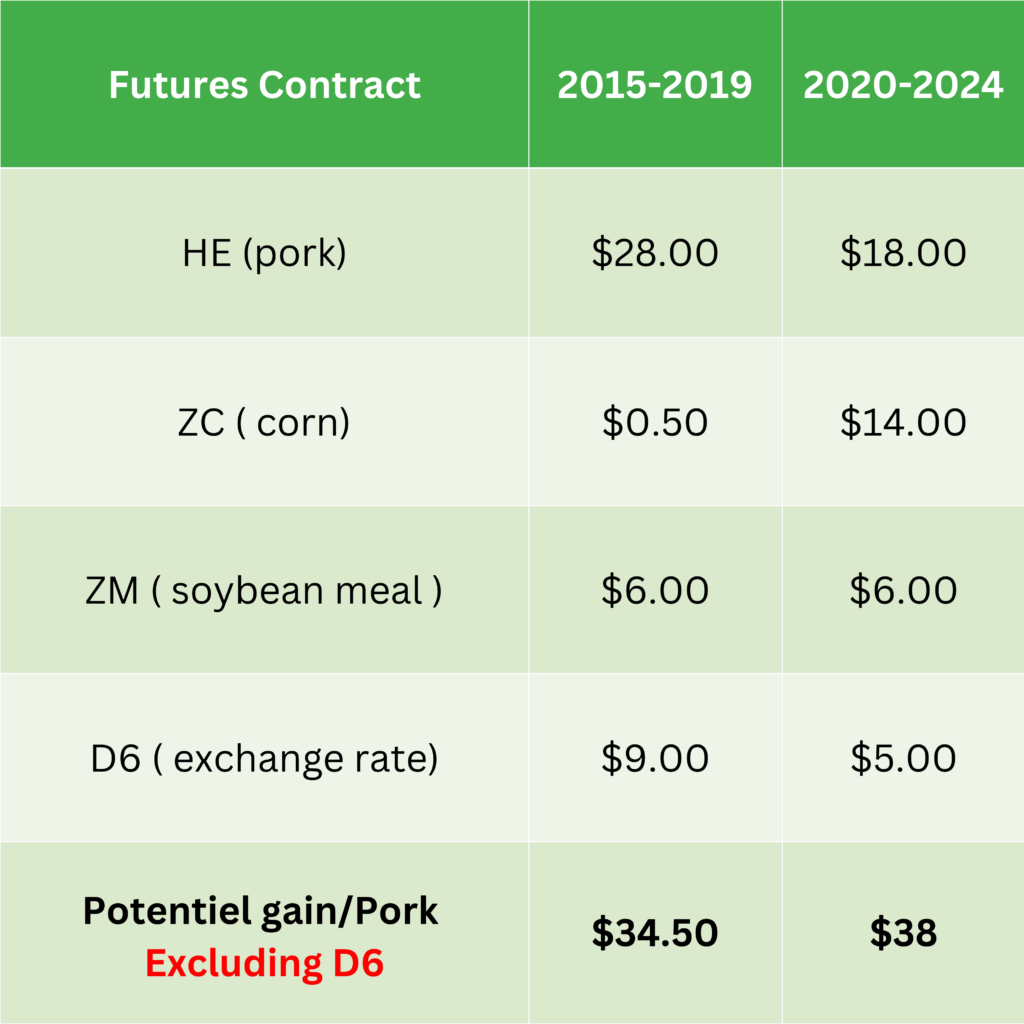
For comparison, hedging HE sales alone represented approximately $18 per hog over the same period. The remainder came mainly from hedging corn and soybean meal.
These results illustrate the importance of an integrated approach to risk management.
What the pork aggregate is not
The Pork Aggregate:
- is not a profit guarantee
- is not a market prediction
- is not a speculative strategy.
It is a structured approach designed to stabilize margins in an environment where several markets simultaneously influence the profitability of pork production.
What this approach requires
The first condition remains the producer’s own understanding.
Participating in an aggregate strategy involves:
- understanding margin logic,
- setting up the necessary credit lines,
- opening the appropriate brokerage accounts,
- monitoring positions,
- and recognizing opportunities as they arise throughout the year.
Integrated risk management requires discipline, rigor, and a long-term vision.
A more resilient agriculture
Modern agriculture operates in an environment where markets are increasingly interconnected.
In this context, managing each variable separately is no longer sufficient.
The challenge is no longer simply selling at the right price.
The challenge is protecting the operation’s ability to generate sustainable margins despite volatility.
This is the logic guiding the development of the Pork Aggregate at Agrintel.