Why and how small farmers can join forces to manage their risks
From grains, oilseeds, and specialty crops to cattle, hogs, poultry, eggs, and dairy products, no farmer escapes the influence of external factors they have no control over. In a single monthly report on agricultural product prices, Statistics Canada cited domestic and foreign demand, input costs like fertilizer prices, growing conditions at home and in foreign producing nations, or interest in biofuel that brings additional environmental factors into the mix. This means that planting and feeding decisions are exposed to all kinds of externalities.
So are borrowing decisions, with investment at risk when access to credit becomes more limited. Large producers, like large players in other sectors of the economy, tend to have deeper pockets and better access to banking and financial market instruments. They have a level of financial resources and sophistication that smaller farmers do not.
This impacts outcomes in the face of uncertainty, particularly when it comes to margins. Facing these risks alone is exposing smaller farmers to even greater uncertainty. Even for those who already hedge their exposures on the futures markets, applying the traditional approach might not be optimal.
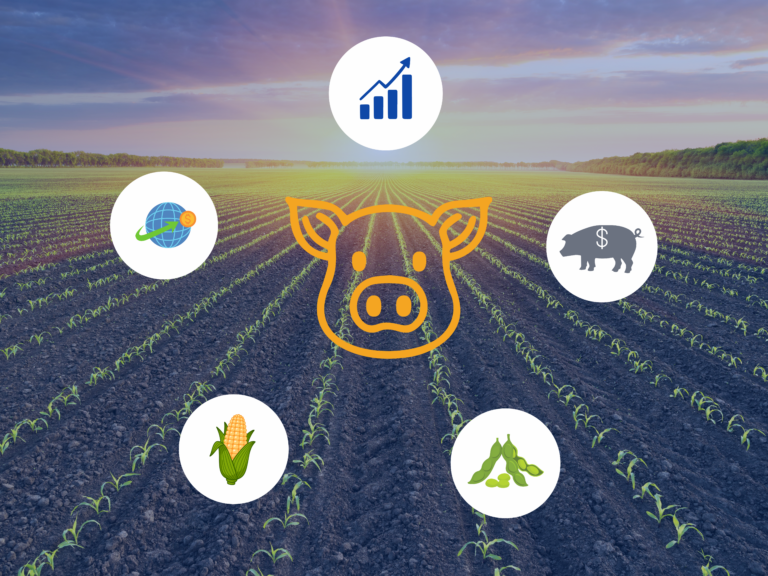
Hog producers, for example, must manage the price for finished pigs, the costs of piglets, corn, soybean meals and the exchange rate. The traditional approach of hedging only one of these factors at a time can leave farms exposed to other factors.
Here is how joining forces can help: farmers can pool resources and risk together to access hedging capability, a bit like investors pool their money into mutual funds. But this alone isn’t enough. The hedging strategy itself matters, just as the mutual fund’s investment philosophy would.
Approaching hedging with a holistic view of the production helps improve margin stability. For instance, it is possible to make a good decision on hog price but still see margins deteriorate simply because the profitability of a pork operation never depends on a single market. Rather, it depends on the selling price of hogs, the cost of piglets, the price of corn, the price of soybean meal and the Canadian dollar exchange rate.
Combining these exposures into a single package of contracts, or aggregate, to lock in both revenues and costs, enables to minimize margin volatility. All components of the aggregate contract are expressed in Canadian dollars per 100 kg of pork. This approach can be applied to other aggregates, like cattle.
Pooling resources together and structuring hedging and risk management around the aggregate approach can help smaller farmers access a degree of financial sophistication that only big players have had access to.
Our data show that such a collective answer combined with an aggregate approach can help reduce margin volatility.
For one group of Quebec farmers, aggregating hedging across hog sales, feed and currency resulted in a cumulative gain of about C$38 per pig between 2020 and 2024, compared to approximately C$18 from hedging only the selling price. The additional margin was achieved by locking in feed and currency costs in advance. The group’s positions from April 2025 to April 2026 show a more stable locked-in price compared to the market price, illustrating the effect of pooled risk management.
Pooling risk does not eliminate all challenges. Farmers need to understand the strategy, set up credit lines and brokerage accounts, and monitor positions throughout the year. While covering all positions does not remove volatility, it can reduce its impact on margins. For small producers who may not have the scale to hedge individually, organizing risk-management groups can provide additional support during periods of instability while strengthening their financial position during more prosperous times.