

The path to self-sustained farming: Profitability
For Canadian farmers, increasing profitability should be the top priority of agriculture policy over the next decade.
A survey* by Angus Reid Institute in partnership with the Canadian Agri-Food Policy Institute shows that 32% percent of farmers identify profitability as their primary concern, more than any other policy area.
However, the data reveals two important challenges for farmers:
1 – The path to achieving and sustaining profit is increasingly obstructed by financial hurdle.
2 – A gap between farmer priorities and their confidence in existing policy frameworks.
The cost challenge
The survey data shows a consistent pattern across key financial challenges, with farmers expressing lower confidence than other industry stakeholders in government policy’s ability to address certain issues.
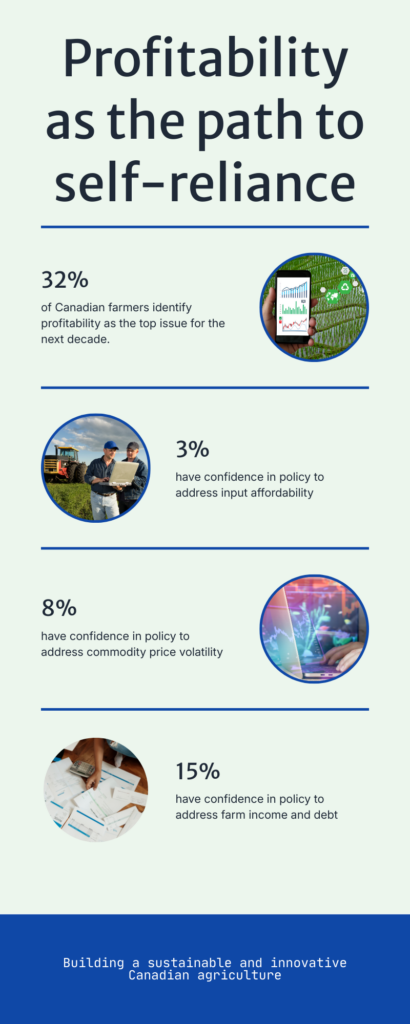
- Input affordability: 3% of farmers confident in government frameworks (compared to 21% of non-farmer industry stakeholders, 24% civil society).
- Commodity price volatility: 8% of farmers confident (13% non-farmer industry, 40% civil society).
- Inflation management: 10% of farmers confident (10% non-farmer industry, 25% civil society)
- Farm income and debt: 15% of farmers are confident (22% civil society).
This disconnect between farmer needs and perceived policy efficacy reinforces the need to reduce reliance on government to increase financial self-sufficiency as the path to a sustainable agricultural sector in Canada.
Geopolitics and weather events pressure margins
The agricultural sector faces significant exposure to U.S. market dynamics. The survey indicates that 78% of all agricultural and agri-food stakeholders are pessimistic about the impact of the current U.S. administration on Canadian agriculture.
Among farmers specifically, the concerns are tangible:
- 56% believe Canada’s trade concentration with the U.S. is too high
- 33% feel confident Canada can effectively mitigate trade disruptions, leaving two thirds uncertain
- 17% feel insulated from potential tariff impacts, meaning that over 80% feel vulnerable.
Across the broader agricultural industry, 38% of stakeholders cite commodity price volatility as a significant threat, a notable increase from previous years.
These international market pressures combine with domestic production challenges. Seventy-five percent of producers report experiencing extreme weather events in the last five years, reducing operational margins and increasing uncertainty.
Building financial resilience
When only 3-10% of farmers have confidence in government frameworks to address key financial challenges, the focus should increase on what can be managed at the farm level.
Farm businesses can increase their financial resilience through effective risk management, which typically addresses four key areas:
- Market price exposure (inputs, commodities, and currency)
- Economic performance and enterprise analysis
- Production efficiency and technical optimization
- Operational risk management, including animal health for livestock operations.
Each of these areas represents a variable that farms can actively manage rather than react to.
Such a proactive approach reduces uncertainty but often requires the combination of human expertise and data-driven tools that help anticipate risks and opportunities that specific to the farm’s unique circumstances.
Financial self-sufficiency also requires operational efficiency. Optimizing production practices according to the latest quality and efficiency standards ensures that every dollar of input generates maximum output. Similarly, robust health coordination and animal health programs are not just about compliance; they are about protecting the farm’s most valuable assets from the “extreme” threats that 37% of the industry associate with environmental shifts.
Cautious optimism
Despite the challenges outlined in the survey, 70% of agricultural and agri-food industry stakeholders remain optimistic about the sector’s future. This overall optimism varies by stakeholder group: government representatives (80%) and civil society (85%) show the highest optimism, while farmers themselves show more cautious optimism at 59%, a reasonable response given their direct exposure to market and production risks.
Farmers understand the operating environment and are looking for concrete solutions to manage it effectively. The combination of realistic assessment and willingness to evolve management approaches suggests Canada’s agricultural sector can position itself to navigate current uncertainties while building toward longer-term profitability and sustainability.
Let’s discuss how Agrintel can help you take control of market risks today to ensure your independence tomorrow.
*About the survey: Conducted by Angus Reid in partnership with the Canadian Agri-Food Policy Institute February 19 – April 1, 2025. Sample of 508 agricultural stakeholders, including 198 farmers, 60 government representatives, and others across the agri-food industry including processors, distributors, and civil society organizations.