
What Is the Right Hedging Level for Your Hog Production and Inputs?
Key takeaway: Determining the right hedging level for hog production is a complex strategic decision that does not depend solely on market fluctuations. It is based on three fundamental pillars: the producer’s psychological tolerance for risk, the business’s financial capacity to meet margin calls, and a clear understanding of production costs and margin over feed costs.
—
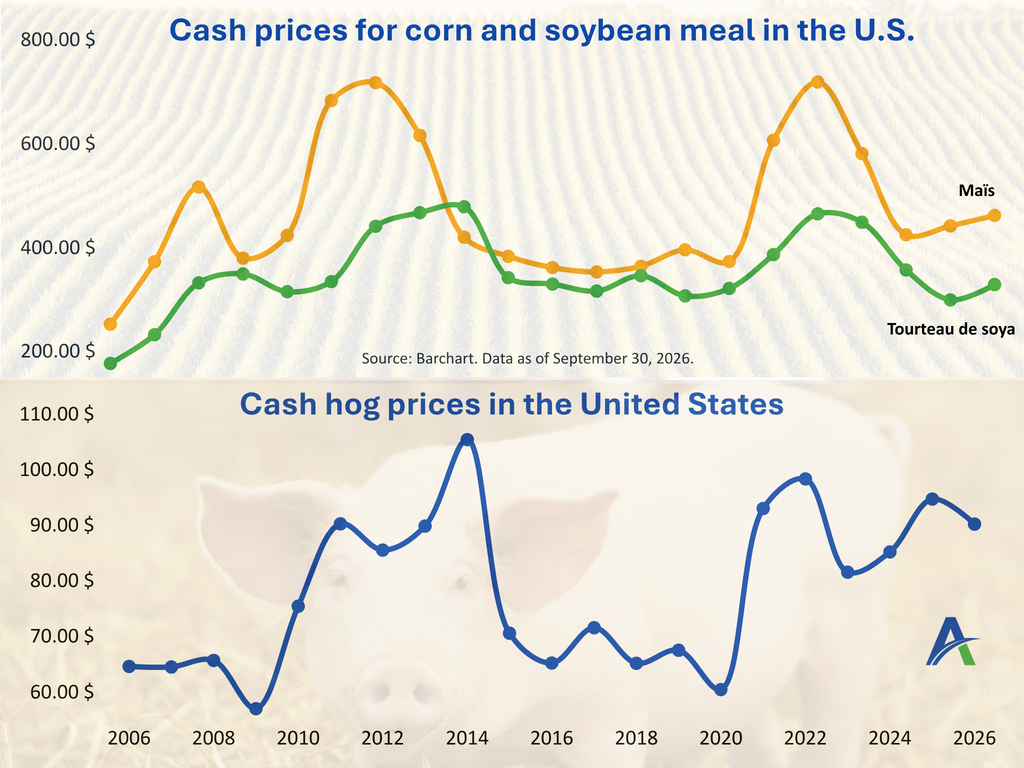
At the last annual general meeting of Groupe Élément-Terre, hog prices were relatively high, while corn and soybean meal prices were relatively low.
Despite these seemingly favourable market conditions, there was still some hesitation about whether to hedge a significant proportion of hog production and key inputs. Several participants were wondering how to determine the proportion of their production to place under risk management
Determining the percentage of production to hedge is a complex decision that involves several considerations.
1. Your risk tolerance
The first consideration is the producer’s attitude toward risk.
- Using futures markets can reduce exposure to price fluctuations.
- It also means accepting that a position taken today may become less advantageous as market conditions change.
- If the market price at the time of sale rises above the price that was secured, the difference may feel like a missed opportunity.
This psychological dimension needs to be taken into account when determining the appropriate hedging level.
2. Your Financial Capacity
Beyond risk tolerance, the decision to use futures markets also depends on the business’s financial capacity to meet potential margin calls.
- Margin calls can be significant, even when they are temporary.
- A business without sufficient liquidity may be forced to liquidate some positions prematurely.
- This can reduce the effectiveness of the hedging strategy.
3. Your Production Costs
Finally, an essential factor in determining the hedging level is understanding your production costs and, in the case of a hog operation, the historical evolution of your margin over feed costs.
Rather than assessing hog prices and input prices separately, it is preferable to look at the margin that can be secured.
If, at a given point in time, market conditions make it possible to lock in a margin that falls within the top quartile of those observed over the past ten years, it may be appropriate to increase the hedging level.
A Practical Example of Risk Management
The beginning of the year illustrates this situation well.
Hog prices were among the highest levels of the past ten years, while feed costs were near historical lows.
The combination of these two factors therefore made it possible to secure particularly attractive margins. Such a context could justify moving closer to the maximum hedging level established by the business.
However, this maximum should not correspond to 100% of production.
Depending on the business’s risk profile, liquidity needs, and strategy, a maximum hedging level ranging, for example, from 50% to 60% of production can secure a significant portion of the margin while maintaining some exposure to favourable market opportunities.